



Cheetahstand
C12 Auto Stand - 12 foot heavy duty
C12 Auto Stand - 12 foot heavy duty
Couldn't load pickup availability
Maximum height. Heavy-duty capacity. Faster workflow.
The Cheetah Stand C12 Auto Stand combines our signature automatic leg system with a heavy-duty design built for larger strobes, bigger modifiers, and demanding professional lighting setups.
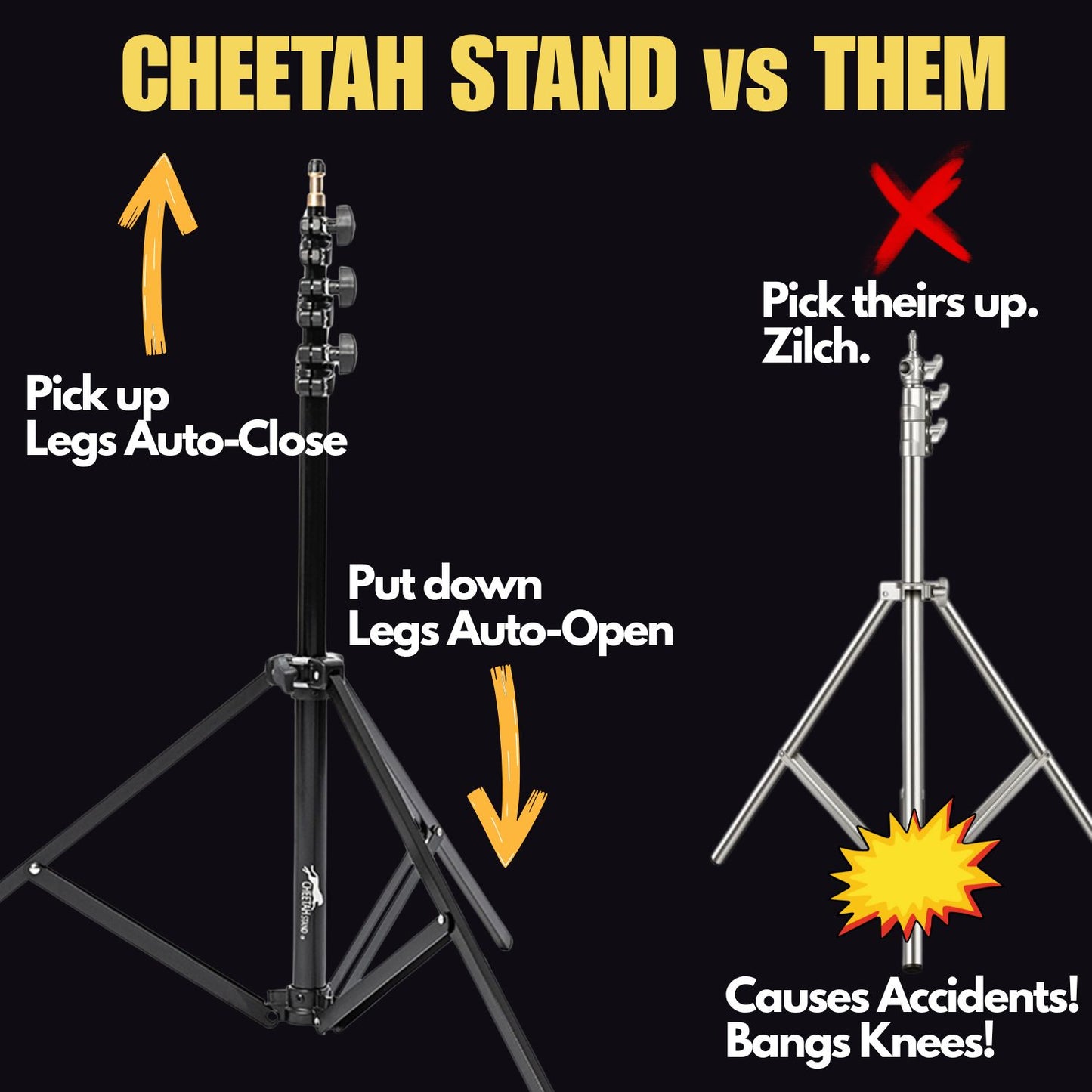
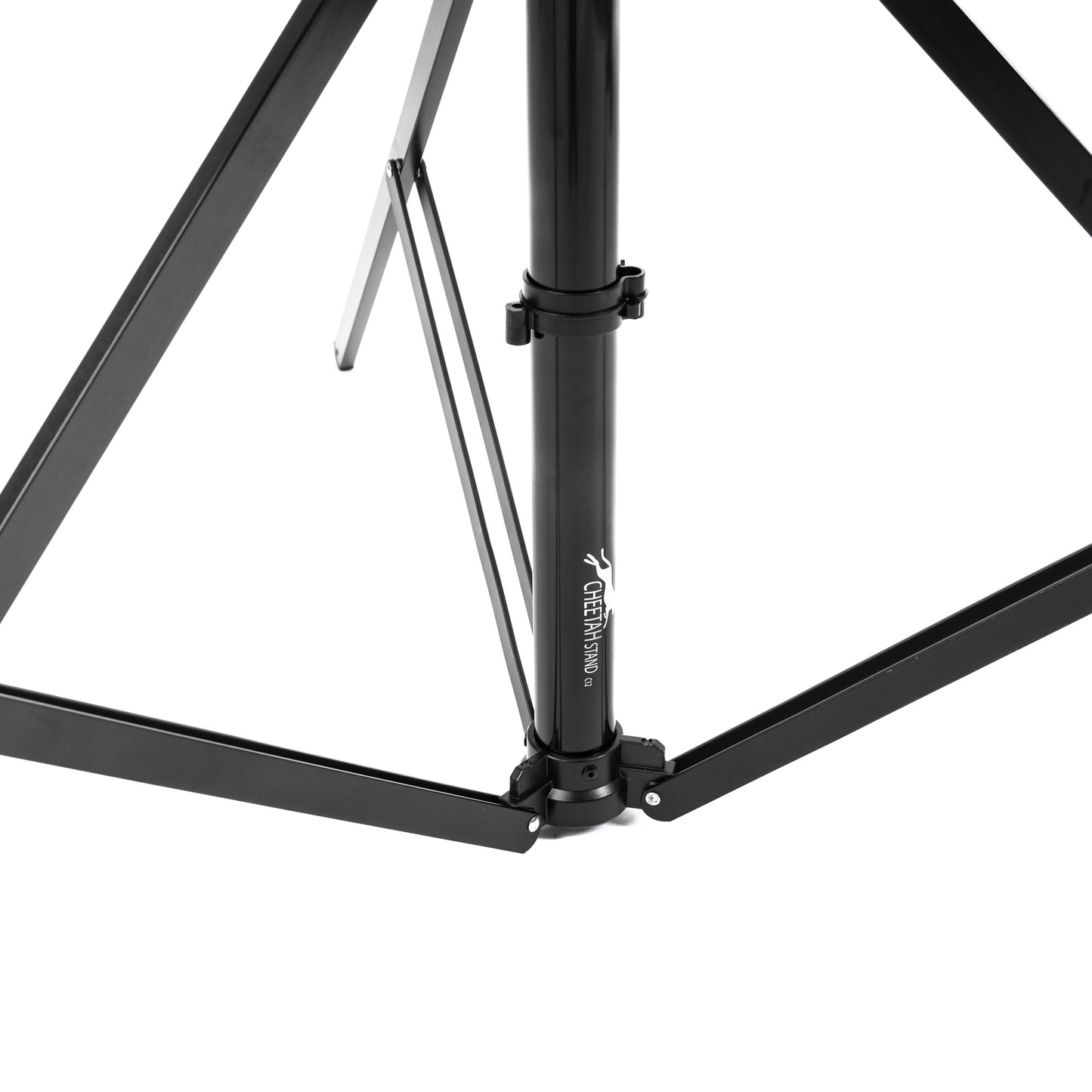
Simply lift the stand and the legs automatically fold in. Set it back down and the legs automatically deploy. No bending over. No manually folding and unfolding tripod legs. Just pick it up, move your light, and keep shooting.
With nearly 12 feet of maximum height and support for lighting setups up to 15 lbs, the C12 is built for photographers who need serious height, stability, and carrying capacity without giving up the speed of a Cheetah Stand.
WHY YOU'LL LOVE IT
⚡ AUTO-OPENING & CLOSING LEGS
This is what makes a Cheetah Stand different.
Pick it up — the legs automatically close.
Set it down — the legs automatically open.
Move your entire lighting setup from one position to another without stopping to manually collapse and reopen the legs.
At weddings, events, sports sessions, and busy location shoots, the C12 helps keep your workflow moving.
📏 12 FEET OF HEIGHT
Sometimes you simply need to get your light higher.
The C12 extends to 144" / 12 feet, giving you the reach needed for elevated key lights, rim lights, large groups, sports portraits, events, and situations where your lighting needs to get above people, obstacles, or large modifiers.
That extra height also makes the C12 an excellent choice for photographers lighting larger spaces.
💪 HEAVY-DUTY 15 LB CAPACITY
The C12 is built for professional lighting setups weighing up to 15 lbs.
That makes it an excellent match for larger battery-powered strobes and modifiers, including setups such as:
- Godox AD200 - AD300 - AD400 - AD600
- Westcott FJ250 - FJ400 - FJ800
- Profoto A2 - B20 -B30- B1X - Pro B3 - D30 - Pro D3
- Large continuous lights
- LED lights
- Large umbrellas
- Up to 48" Softbox
- Medium to large lighting modifiers
When your setup is too much for a lightweight stand, the C12 gives you the capacity to step up.
📸 BUILT FOR PROFESSIONAL LOCATION WORK
The C12 is designed for photographers who need serious lighting equipment without sacrificing mobility.
Perfect for:
- Sports portraits
- Weddings
- Events
- Large group photography
- On-location portraits
- Commercial photography
- School photography
- Corporate photography
- Studio work
- Large modifier setups
Lift the stand when you need to reposition your light. The legs close automatically, making it easier to navigate around people, furniture, equipment, and busy shooting environments.
🏋️ HEAVY DUTY WITHOUT GIVING UP MOBILITY
At approximately 7 lbs, the C12 provides substantially more height and load capacity while remaining portable enough for professional location work.
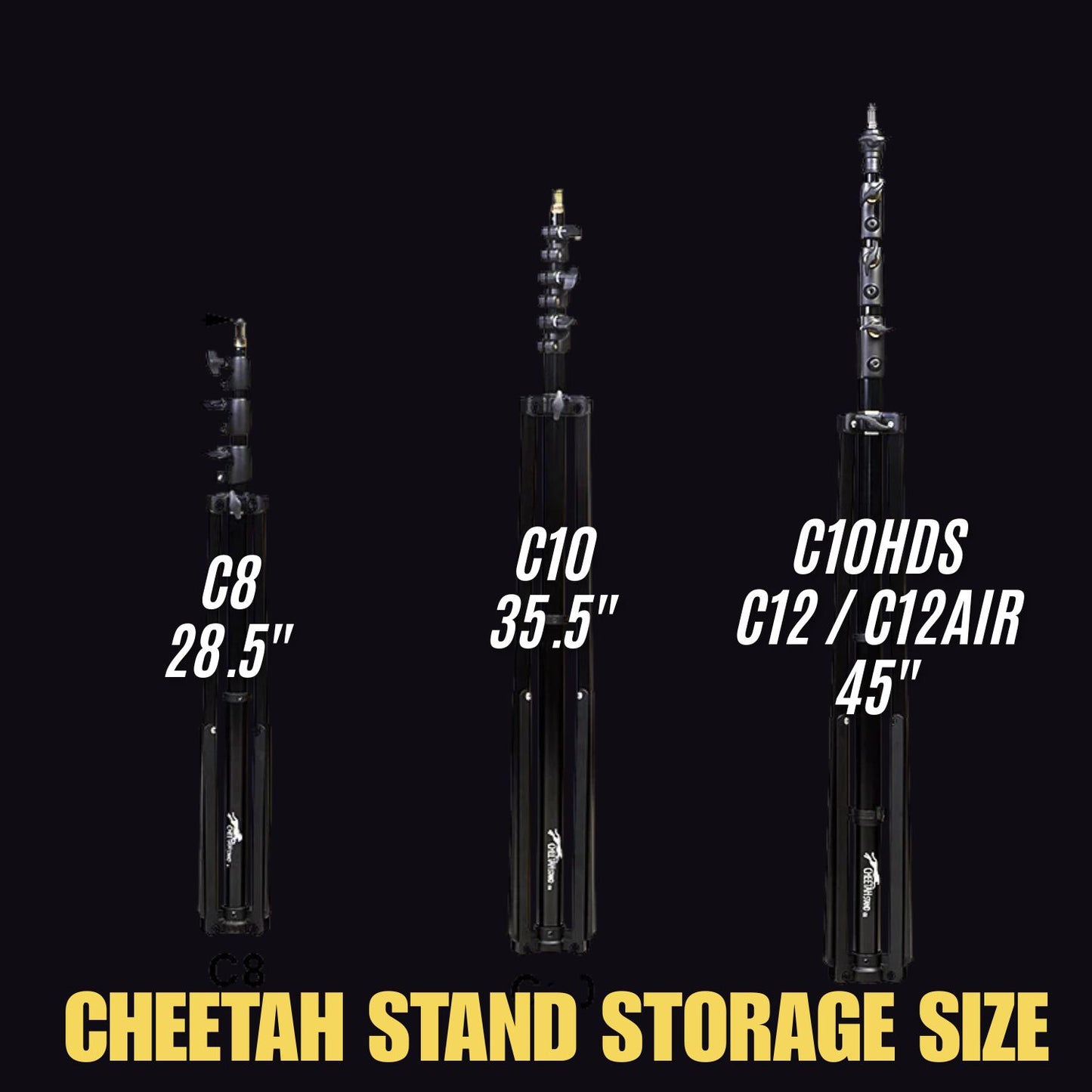
Its wide 42" footprint creates a substantial base when deployed, while the stand collapses down to 43" for transportation and storage.
LESS BENDING. FASTER WORKFLOW.
Moving a traditional heavy-duty light stand can interrupt your entire shooting rhythm.
Bend down. Fold the legs. Lift the stand. Move it. Reopen the legs. Reposition your light.
The C12 simplifies the process.
Lift it. Move it. Set it down. Keep shooting.
The bigger and heavier your lighting setup becomes, the more valuable that workflow can be.
BUILT TO KEEP WORKING
Cheetah Stand supports the C12 with replaceable maintenance and repair parts, helping you keep your stand working instead of replacing the entire stand when individual components wear over time.
Professional equipment should be built to work—and built to be maintained.
C12 SPECIFICATIONS
Maximum Height: 144" / 12 ft
Minimum Height: 45"
Closed Length: 43"
Footprint: 42"
Stand Weight: 7 lbs
Maximum Load: 21 lbs
Leg System: Automatic opening and closing
Mount: 3/8" Spigot
BEST FOR
Large Strobes • AD600-Class Lights • FJ800 • Profoto B1X • Large Softboxes • Umbrellas • Sports Portraits • Weddings • Events • Location Photography
WHICH CHEETAH STAND IS RIGHT FOR YOU?
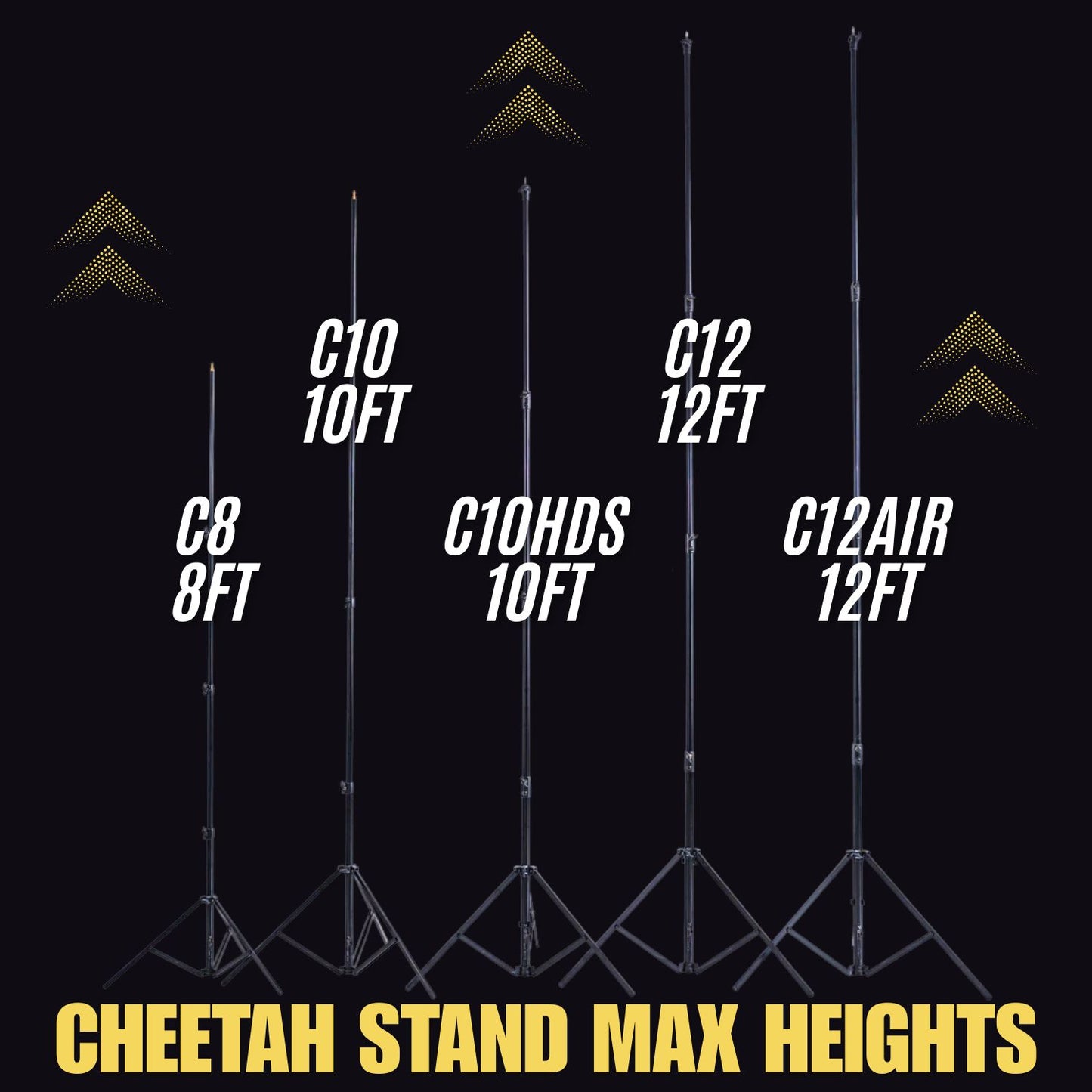
C8 Auto Stand
Compact and lightweight. Best for speedlights, small lights, umbrellas, and lightweight modifiers. 8' max height with 32" footprint.
C10 Auto Stand
More height and carrying capacity. A versatile choice for compact strobes and small-to-medium modifiers. 10' max height with 38" footprint.
C10 HDS / Heavy Duty Auto Stand with Springs
Built for larger strobes, larger modifiers, and heavier professional lighting setups. Heavy duty springs to protect your light in case of an accidental slip. 10' max height with 40" footprint.
C12 / Heavy Duty Auto Stand
Built for larger strobes, larger modifiers, and heavier professional lighting setups. Widest footprint for max stability. 12' max height with 42" footprint.
C12 AIR / Heavy Duty Auto Stand with Air Cushions
Built for larger strobes, larger modifiers, and heavier professional lighting setups. Widest footprint for max stability. Air cushioned for assisted lowering of heavier setups. 12' max height with 42" footprint.
THE HEAVY-DUTY CHEETAH STAND EXPERIENCE
The C12 gives you the height and strength needed for serious lighting setups while keeping the automatic workflow that makes Cheetah Stand different.
More height. More capacity. Less setup.
Pick it up. Move it. Set it down. Keep shooting.
WHAT'S INCLUDED
1 × Cheetah Stand C12 Auto 12 ft Heavy Duty Light Stand
1 × 3/8" Spigot
Unsure on which stand you need? Use our Recommendation and Comparison tool to determine which stand works best for you and your project.
Frequently Asked Questions
1. What's the biggest misconception photographers have about investing in auto light stands?
2. How do auto light stands help me achieve a cleaner, more organized shooting space?
3. Can using auto light stands actually reduce physical fatigue during long photography sessions?
4. What are the key elements of an auto light stand's design that ensure long-term durability?
5. How does the type of leg spread (e.g., symmetrical, asymmetrical) impact an auto light stand's functionality?
6. Are there specific types of locking mechanisms I should look for in the column sections of an auto light stand?
7. How do auto light stands support the use of various power sources, like battery packs or external power supplies?
8. What are the advantages of using wheeled auto light stands for studio or large-space photography?
9. How does the material finish (e.g., anodized, powder-coated) on an auto light stand contribute to its practical use?
10. Can auto light stands improve my results when working with complex, multi-light setups?
11. What role does the "minimum height" specification play when choosing an auto light stand?
12. How do auto light stands impact the longevity of my light modifiers like softboxes and umbrellas?
13. Is there a 'best' way to collapse and store an auto light stand to ensure its mechanisms last?
14. What are some indicators that an auto light stand might be of lower quality and prone to issues?
15. How does choosing the right auto light stand empower my overall photographic artistry and creative expression?
Share






Build - Excellent, Design- Excellent, Weight in bag - Very Good, Ease of Use - Excellent, Durability - New item for me - to be determined.
I will let you know the next time I need to use it.
This is my second stand! And I am so happy with my purchase!
As a portrait photographer, I've wrestled with more light stands than I care to count, and the C12 Auto Stand has genuinely transformed how I work on set. This 12-foot heavy-duty stand solves problems I didn't even realize were slowing me down.
The pneumatic system is brilliant. Instead of fighting with knobs and levers while balancing a strobe and modifier, I simply lift or lower the stand to exactly where I need it, and it glides into position effortlessly. When I'm shaping light on a client's face and need to raise my key light just two inches, or when I'm switching from a seated to standing pose, I'm making micro-adjustments in seconds instead of stopping the entire flow of the session. That responsiveness keeps my clients engaged and the energy alive.
And can we talk about the fingers? I cannot overstate how much I appreciate that this stand doesn't attack my hands. Every photographer knows that awful pinch from traditional stands when you're loosening a knob under pressure from a heavy modifier. With the C12, my fingers stay safe, which means I stay focused on my subject instead of nursing a blood blister between setups.
The 12-foot height range gives me incredible versatility. I can achieve that beautiful clamshell lighting setup with an overhead fill, create dramatic Rembrandt lighting from above, or boom out a hair light without needing a separate boom arm for every situation. The heavy-duty construction handles my large parabolic umbrellas even in outdoor conditions without that terrifying wobble.
For portrait photographers who value efficiency, safety, and precise light control, the C12 Auto Stand is worth every penny. It's one of those tools that earns its place in my kit by simply getting out of my way and letting me create. Thanks, Cheetah Team, for helping me reach new heights in my business with your equipment!
Nice stand with strong build quality. I think for the 12’ stand the knobs should be a little larger but didn’t hold me back from buying. All aluminum but has some good weight to the stand for when used outdoors with a modifier on it should hold well. The point of the cheetah stand is that the legs auto fold up when you pick up the stand and auto extend when you set the stand down, so it’s fast to set up and take down. These stands work great in church/weddings when you need to set up lights in between pews. I have only had the stand for a week but know it will last a very long time.